Global Surface Treatment Equipment & System Solutions — Since 2002

久昌机械
Get a Quote
Global Surface Treatment Equipment & System Solutions — Since 2002
久昌机械
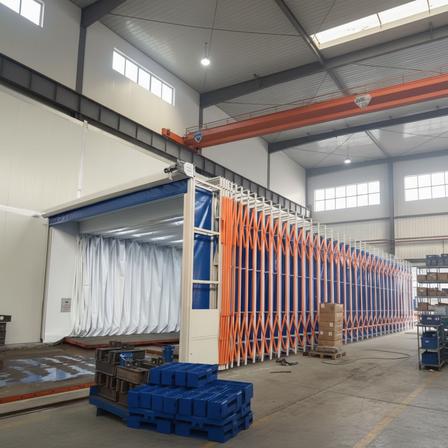
Flexible Mobile Sandblasting for Large Workpieces
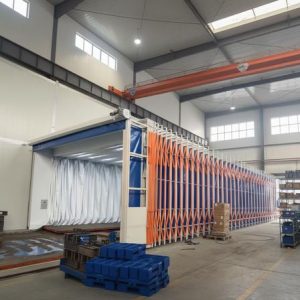
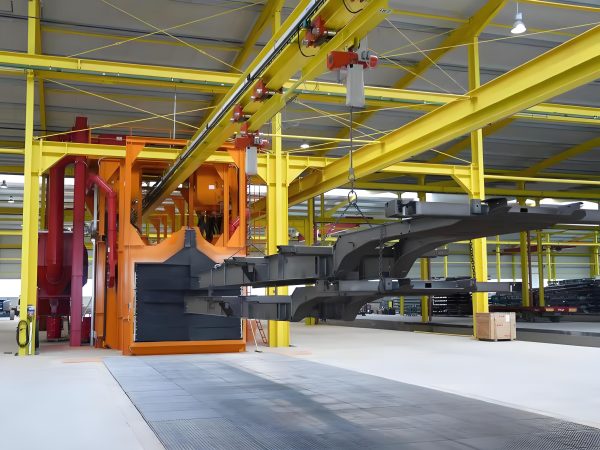
The telescopic sandblasting room is designed for large, irregular, and heavy workpieces. It uses a modular steel frame and flame-retardant sealed tarpaulin structure, with ground-track drive to extend and retract the room body. During operation, it expands to form a fully enclosed sandblasting space. When idle, it retracts to release floor space, eliminating the dependence of traditional fixed sandblasting rooms on crane turnover and dedicated transport aisles. It is widely used for surface pretreatment before coating in steel structures, shipbuilding, wind power, construction machinery, and related industries.
The room body consists of multiple steel gantry frames connected by scissor-link mechanisms. Dual geared motors drive trolleys along ground rails, using the parallelogram principle to ensure that all frames expand or retract at equal spacing. Flame-retardant PVC canvas or fiberglass composite fabric forms a sealed working room between frames. The folded-weir bottom design works with a slight negative-pressure dust collection system to ensure zero abrasive leakage.
Standard process flow: room retracted -> crane places workpiece in position -> room expanded -> dust collection and blasting systems started -> sandblasting and cleaning -> room retracted -> workpiece moved out. A single expansion or retraction cycle usually takes no more than 2 minutes.
Space efficiency and flexible production: After retraction, more than 60% of the floor area is released, enabling multiple processes to share the same work area without reserving a fixed enclosed room for sandblasting.
Simplified process: The crane can place workpieces directly from the transverse or longitudinal direction, without dedicated transport equipment. Workpiece size is not restricted by a fixed room body.
Safety and compliance: Dual geared-motor interlock drive, variable-frequency speed control, limit switches, and audible/visual warning systems comply with international machinery safety directives. PLC-linked control supports one-touch start/stop and emergency-stop protection.
Environmental protection and resource recovery: Abrasive recovery rate is >=98%, and dust emission concentration is stable below 30 mg/m3, meeting GB 16297 and equivalent international emission standards.
Low TCO: Manufacturing cost is lower than that of fixed rooms of the same scale. Sealing tarpaulin can be quickly replaced, driven wheel sets only require regular lubrication, and annual maintenance downtime is short.
Smart digitalization: The PLC system supports linked control of telescopic movement, blasting, and dust collection. Optional remote status monitoring and fault diagnosis can connect to factory MES/SCADA systems.
Global compliance certification: Products pass CE and ISO 9001 quality management system certification. Electrical systems comply with IEC standards and can be adapted to UL/CSA and other North American certification requirements, meeting global procurement standards of multinational enterprises.
Turnkey engineering capability: We provide full-process services from site survey, 3D layout simulation, and foundation design to installation and commissioning. Room width, height up to 8 m+, and expanded length can all be custom-engineered according to workpiece specifications.
Energy efficiency and sustainability: Variable-frequency drive and intelligent air-valve linkage reduce no-load energy consumption. Closed-loop abrasive recovery and high-efficiency dust collection reduce raw material waste and dust emissions, supporting EHS and carbon-reduction goals.
Lifecycle support: A global spare-parts logistics network, remote PLC diagnosis and software upgrades, and 24/7 technical support response are available. Operation training, annual maintenance contracts, and spare-parts packages help ensure equipment OEE.
International project experience: We have successfully delivered projects to Europe, Southeast Asia, the Middle East, and South America, adapting to wide temperature ranges from -20 deg C to 80 deg C and demanding industrial environments with high humidity and high salt spray.
|
Parameter |
Unit |
SSF-6 |
SSF-8 |
SSF-10 |
SSF-12 |
|
Expanded size |
m |
6 x 4 x 4 |
8 x 5 x 4 |
10 x 6 x 4.5 |
12 x 6 x 4.5 |
|
Retracted size |
m |
approx. 2.5 x 4 x 4 |
approx. 3 x 5 x 4 |
approx. 3.5 x 6 x 4.5 |
approx. 4 x 6 x 4.5 |
|
Applicable workpiece size |
m |
<=4 x 3 x 3 |
<=6 x 4 x 3.5 |
<=8 x 5 x 4 |
<=10 x 5 x 4 |
|
Number of spray guns |
pcs |
2-4 |
4-6 |
4-6 |
6-8 |
|
Blasting pressure |
MPa |
0.4-0.8 |
0.4-0.8 |
0.4-0.8 |
0.4-0.8 |
|
Compressed air consumption |
m3/min |
6-12 |
12-20 |
20-30 |
30-45 |
|
Area per gun |
m2/h |
10-20 |
15-25 |
15-25 |
20-30 |
|
Telescopic speed |
m/min |
6-10 |
6-12 |
8-15 |
8-15 |
|
Drive power |
kW |
1.5 x 2 |
2.2 x 2 |
3.0 x 2 |
3.0 x 2 |
|
Abrasive recovery rate |
% |
>=98 |
>=98 |
>=98 |
>=98 |
|
Emission concentration |
mg/m3 |
<50 |
<50 |
<50 |
<50 |
|
Illuminance |
Lux |
>=300 |
>=300 |
>=500 |
>=500 |
|
Installed power |
kW |
approx. 15 |
approx. 25 |
approx. 35 |
approx. 50 |
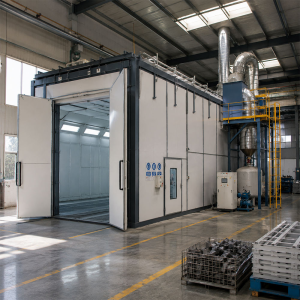
It is suitable for sandblasting and cleaning of large complete machines and components in steel structures, shipbuilding, construction machinery, wind power equipment, bridges, containers, railway carriages, petrochemical equipment, and machine tools. It is especially suitable for rust removal, oxide scale removal, and surface roughening of overweight, overlong, and irregular workpieces such as wind turbine blades, welded structures, castings, steel pipes, oil tanks, and boilers. It is designed for smart manufacturing workshops with limited site space and shared multi-process work areas.
The telescopic type can move, expand, and retract, saving floor space and making it suitable for large irregular workpieces. A fixed room does not move and requires workpieces to be transported into the room, making it more suitable for batch small workpieces. The telescopic type has lower construction cost and higher space utilization, while its sealing performance reaches the same level through folded-weir design and a slight negative-pressure system.
Flame-retardant canvas is used between frames for sealing, and the contact area between canvas and floor uses a folded-weir design. Together with the slight negative-pressure dust collection system, the abrasive recovery rate reaches >=98% and zero abrasive leakage is achieved. Regular inspection of canvas and sealing strips ensures continuous stability.
Room size is customized as required. Expanded length can exceed 18 m, width is typically 4-8 m, and height can reach 8 m. Workpiece weight is not limited because the crane places the workpiece directly in position, solving the size limitation problem of fixed rooms.
Variable-frequency speed control is 6-15 m/min. For a 10 m room length at 10 m/min, full expansion or retraction takes about 1 minute. Dual geared-motor interlock drive ensures smooth movement, with limit switches and audible/visual warning systems.
Conventional flame-retardant coated PVC canvas withstands -20 deg C to 80 deg C and has a service life of 3-5 years. Wear-resistant fiberglass composite fabric provides better abrasion resistance, and actual cases show more than 8 years of continuous use without damage. All tarpaulins can be replaced quickly with low maintenance cost.
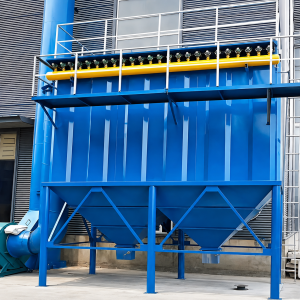
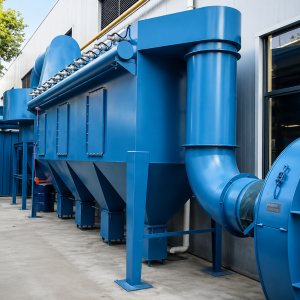
Cartridge or bag dust collectors are used as terminal treatment equipment. Emission concentration is stably below 30 mg/m3, complying with China's GB 16297 and equivalent international emission standards and meeting EHS audit requirements of multinational companies.
Taking SSF-6 as an example, the retracted room footprint is about 10 m2, and the expanded footprint is about 24 m2. Including rails, abrasive storage area, and operating passages, the recommended total footprint is no less than 80 m2. Rail foundation and electrical control cabinet locations should be reserved during installation, and workshop height of >=5 m is recommended.
Main wearing parts include sealing tarpaulin, driven wheel sets, drive chains, and limit switches. Tarpaulin can be quickly replaced; driven wheel sets require regular lubrication; chains require regular tension inspection. Routine maintenance workload is low, the failure rate is low, and annual maintenance downtime is short.
A quotation requires maximum workpiece size and weight, daily processing capacity requirement, blasting grade and roughness requirement, workpiece material, installation site dimensions, and compressed-air source conditions. We provide free on-site survey, 3D layout simulation, and solution design services.

English

Hindi

Indonesian

Russian

Spanish

Thai

Vietnamese