Global Surface Treatment Equipment & System Solutions — Since 2002

久昌机械
Get a Quote
Global Surface Treatment Equipment & System Solutions — Since 2002
久昌机械

Machine selection, customisation, delivery, maintenance and compliance — answered by our engineers.
Yes. Simply provide a photo of the equipment nameplate or the factory model number. Our technical team can retrieve the corresponding BOM (Bill of Materials) and provide a Recommended List of Commonly Stocked Wear Parts and an Annual Maintenance Package free of charge, together with recommended replacement intervals for key components.
We recommend following a “6+1” spare parts stocking principle: keep at least six categories of frequently replaced wear parts on site—blast wheel blades, elevator buckets, elevator belts/chains, wear plates, bearings, and seals—plus one set of critical assembly spares, such as a track assembly or slewing bearing, depending on the machine type.
We can provide a customized spare parts list free of charge based on your equipment model and production capacity.
Standard spare parts are supplied through our global regional stock network and are normally shipped from the nearest warehouse within 3–7 business days after order confirmation. Custom parts, including special-length tracks, customized roller conveyors, special fixtures, and large slewing bearings, can be manufactured according to drawings or samples, with a typical lead time of 10–15 days. Expedited production can be discussed for urgent requirements.
Three options are available:
For non-standard fixtures or tooling, we also recommend providing workpiece drawings and weight information so that the load-bearing capacity can be properly verified.
We match the optimal machine based on your key parameters: workpiece type (plate, structural parts, pipes, castings, wire coils, etc.), size/weight, hourly throughput, cleaning/strengthening goal, floor space, and local emission standards. Examples:
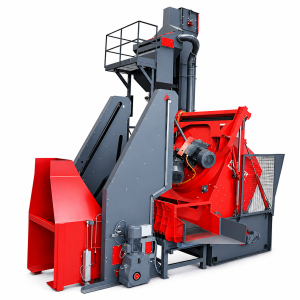
Small batch castings → tumbler or drum blaster
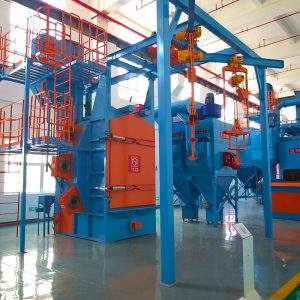
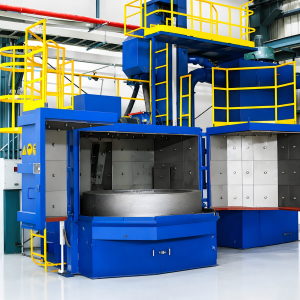
Heavy non-standard structures → hook/suspension or table/rotary blaster
Wire coils → coil blasting machine
Automated plate pre-treatment → roller conveyor line (with optional painting/powder coating integration)
We match the optimal machine based on your key parameters: workpiece type (plate, structural parts, pipes, castings, wire coils, etc.), size/weight, hourly throughput, cleaning/strengthening goal, floor space, and local emission standards. Examples:
Small batch castings → tumbler or drum blaster
Heavy non-standard structures → hook/suspension or table/rotary blaster
Wire coils → coil blasting machine
Automated plate pre-treatment → roller conveyor line (with optional painting/powder coating integration)
Our service network includes 62 service locations across 22 countries and regions, supported by multiple overseas regional warehouses.
The standard support process is: Remote video diagnosis → spare parts shipment from the nearest regional warehouse → on-site support from a local partner engineer if required.
During installation, we provide multilingual manuals and real-time video guidance. For complex failures, regional engineers can be dispatched for on-site support. In areas covered by our overseas regional warehouse network, on-site support can typically be arranged within 5 business days.
Contract customers receive priority support, including:
For major failures resulting in production line shutdowns, emergency stock transfer or air freight can be activated.
The service life of wear parts depends heavily on operating conditions, including abrasive hardness, moisture content, continuous operating hours, and ambient temperature, so there is no single replacement interval applicable to all machines.
We recommend establishing a dedicated inspection record for each machine, determining replacement timing through periodic measurement, and using our Reference Table for Replacement Intervals of Key Components as a preventive maintenance guideline. Under harsh conditions such as high temperature, high humidity, or coastal salt-spray environments, we recommend increasing inspection frequency by approximately 30%–50%.
Structural components and standard purchased parts, such as motors and gear reducers, are covered by a 12-month warranty. Consumable wear parts, including blades, tracks, and sealing strips, are covered for 3 months or 500 operating hours, whichever comes first.
The warranty covers only material and manufacturing defects. Damage caused by operating conditions beyond specified limits, such as damp abrasive media, unstable voltage, or overloaded operation, is not covered.
We recommend contacting our Remote Diagnostic Center first. Based on equipment operating videos, motor current data, and photos of the workpiece cleaning results, our engineers can make an initial assessment of whether the issue is caused by component wear or process parameters. If necessary, an on-site inspection can be arranged to avoid unnecessary part replacement.
Installation acceptance is based on the technical agreement signed by both parties. If the cleaning result, equipment vibration, and dust emissions all meet the agreed requirements during the load test, any subsequent performance deterioration caused by contaminated abrasive media, changes in workpieces, loosening of the control cage, or similar operating factors is considered an operation and maintenance issue rather than an installation issue.
Such issues can be addressed through an Annual Maintenance Contract or a one-time technical service.
The main operating costs include electricity consumption, abrasive media consumption, wear-part replacement, dust collector filter cartridge replacement, labor, and equipment maintenance.
Abrasive media and wear parts are continuous operating expenses. Proper abrasive selection and appropriate maintenance practices can significantly reduce long-term operating costs.
Yes. We can provide customized shot blasting solutions based on the customer’s workpiece dimensions, production capacity, workshop layout, and required level of automation. Customization can include equipment dimensions, number of blast wheels, conveying method, dust collection configuration, and electrical control system.
For customized projects, detailed technical discussions are carried out before the final solution is confirmed, and complete engineering drawings are retained for future spare parts ordering and technical support.

English

Hindi

Indonesian

Russian

Spanish

Thai

Vietnamese