Global Surface Treatment Equipment & System Solutions — Since 2002

久昌机械
Get a Quote
Global Surface Treatment Equipment & System Solutions — Since 2002
久昌机械
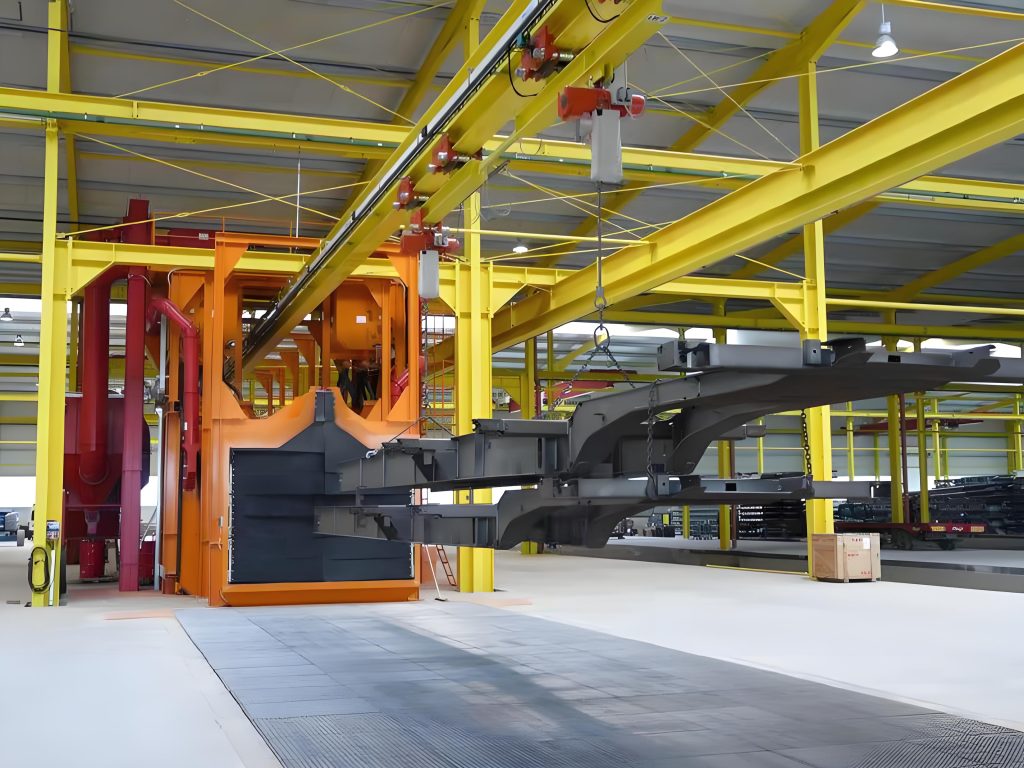
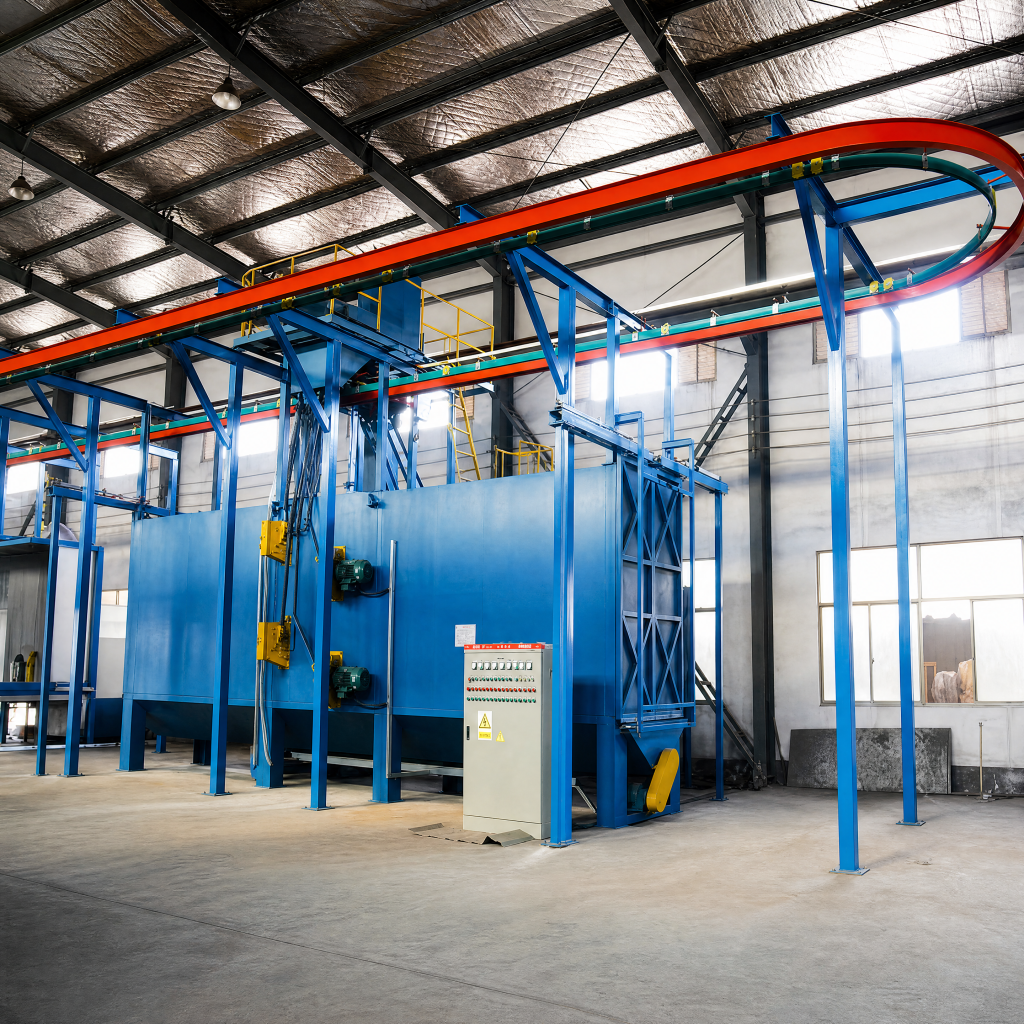
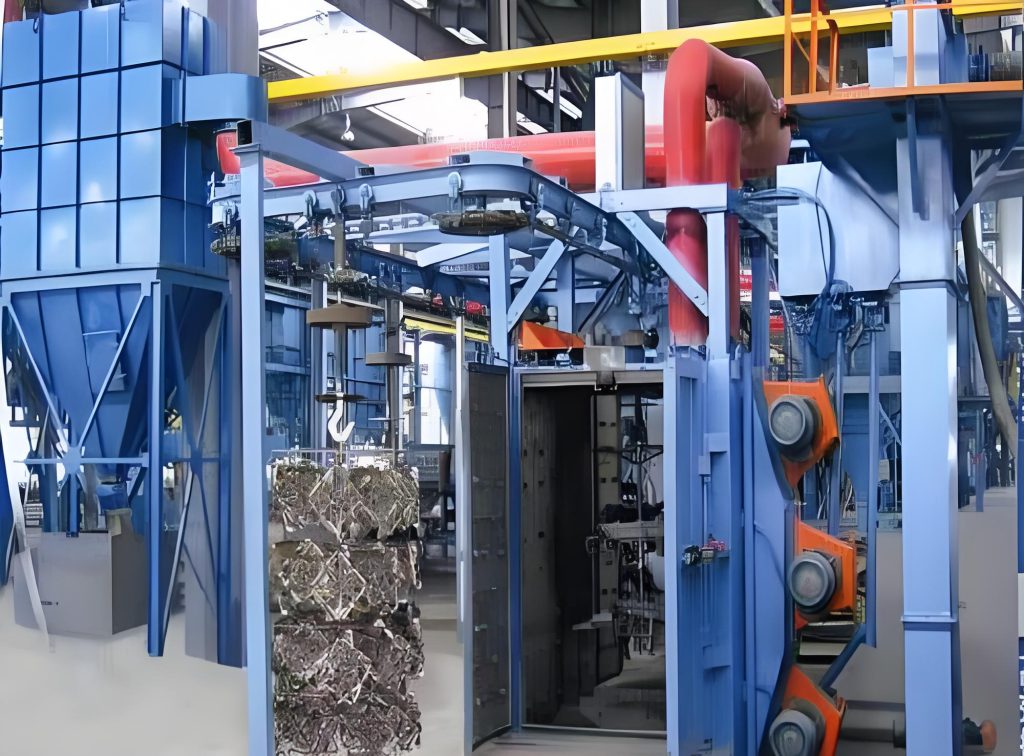
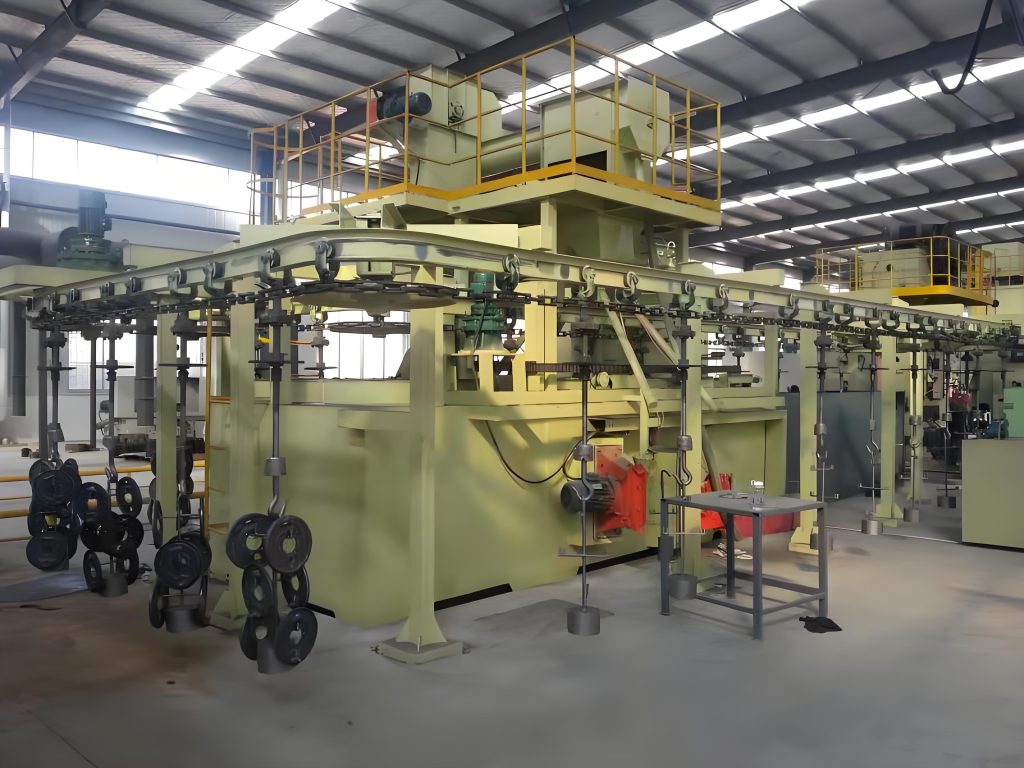
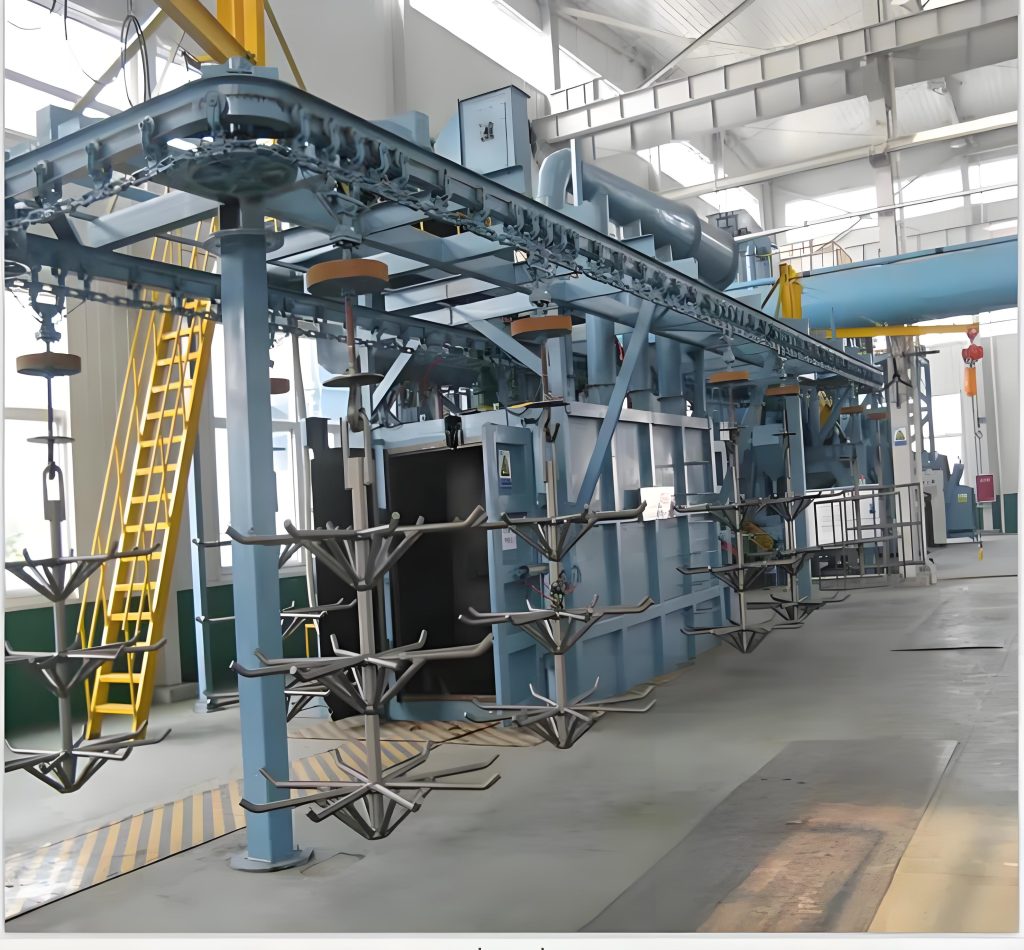
Specialized surface cleaning equipment for high-volume continuous production lines · Q38 / Q48 / Q58 Series
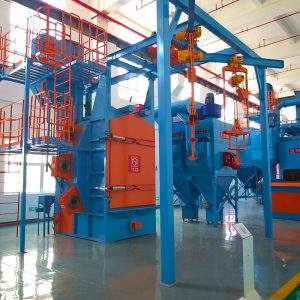
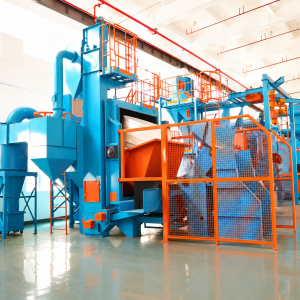
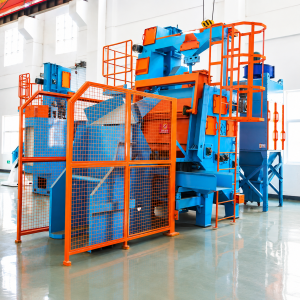
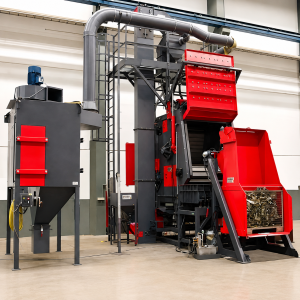
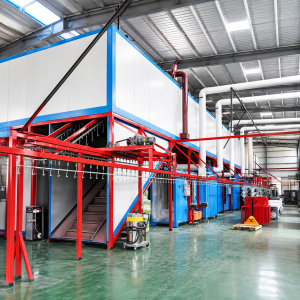
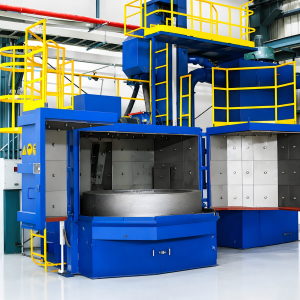
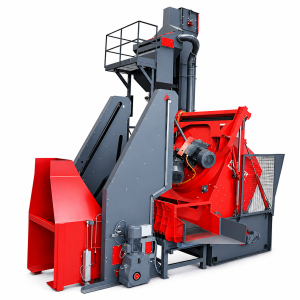
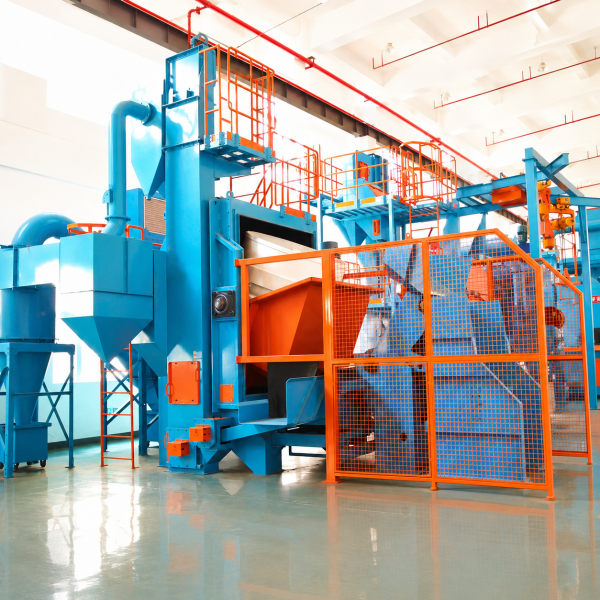
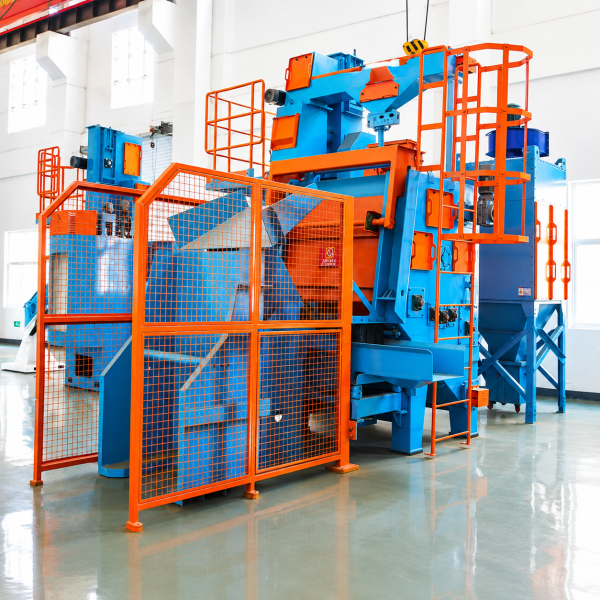
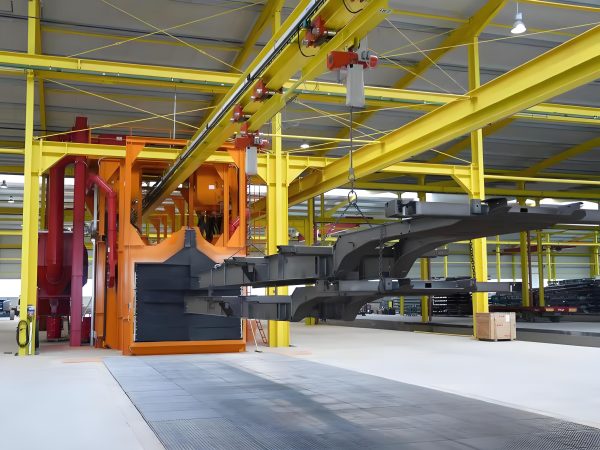
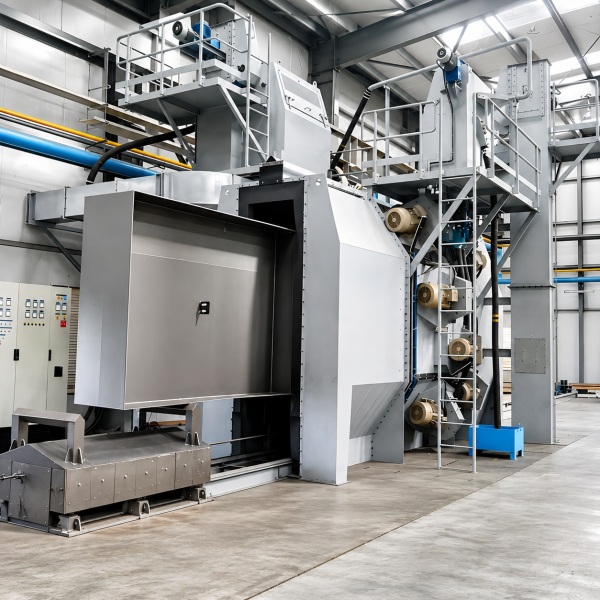
The overhead conveyor shot blasting machine (Q38/Q48/Q58 series) is a specialized piece of equipment designed for large-volume, continuous surface cleaning of medium to large-sized workpieces such as castings, forgings, welded parts, and heat-treated parts. Workpieces are suspended by hooks or special hangers on the overhead conveyor and continuously or in a step-by-step manner fed into the enclosed shot blasting chamber by a conveyor system. Multiple shot blasters propel projectiles at high speed from the sides and top at multiple angles. The workpieces rotate or oscillate within the blasting zone, achieving 360° all-around cleaning.
The equipment is available in three types based on the conveying method:
Continuous (Q38 series): The overhead conveyor runs continuously at a uniform speed, suitable for large batches of single-type or similar-sized workpieces;
Step-by-step (Q48 series): The overhead conveyor moves in a step-by-step manner, allowing workpieces to remain in the cleaning chamber for a longer period, suitable for high-level cleaning requirements or complex workpieces;
Accumulating (Q58 series): The overhead conveyor has an accumulation function, allowing pauses at designated stations, suitable for multi-type mixed-production lines and pre-coating treatment line integration.
Workpieces are suspended on a overhead conveyor using specialized hangers or hooks and fed into a closed shot blasting chamber by a drive system at a set speed (continuous) or rhythm (stepping/accumulating). Multiple shot blasters propel projectiles at high speed from different angles. The workpiece is impacted by the projectiles within the blasting zone, while the hook's rotation mechanism drives the workpiece to rotate, ensuring that all surfaces, including internal cavities and grooves, are fully blasted.
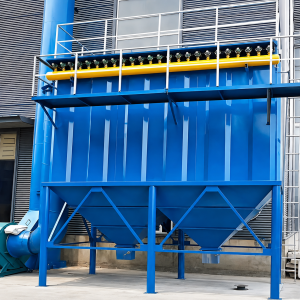
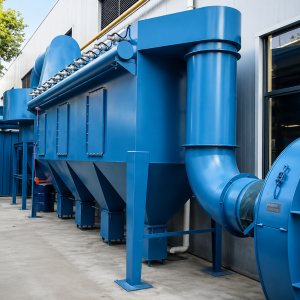
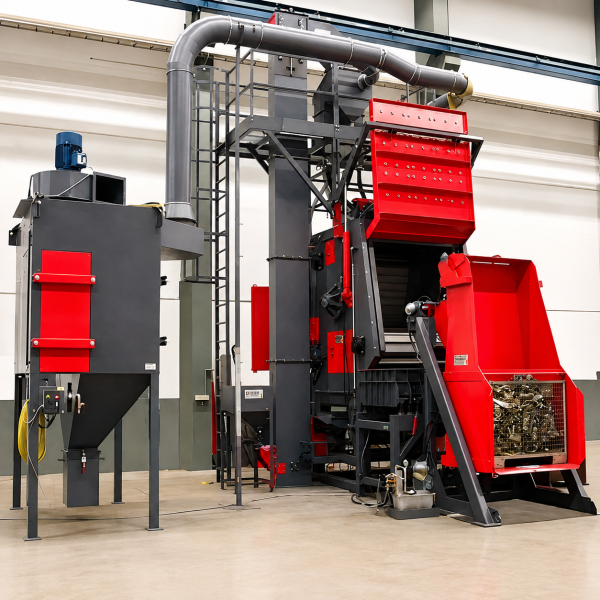
The projectiles are recovered by a scraper at the bottom of the chamber, conveyed by a screw conveyor, and lifted by a bucket elevator into an air separator for separation and recycling. Dust and broken shot are filtered by a pulse jet filter/bag filter system before being discharged in compliance with standards. After cleaning, the workpiece is conveyed out of the chamber via an overhead conveyor to the unloading area or subsequent coating/drying station.
Process Flow: Loading hanger → Overhead conveyor into chamber → Shot blasting (+ hook rotation) → Overhead conveyor out of chamber → Shot cleaning → Unloading/Transfer to coating
The shot blasting machine adopts a high-efficiency direct-drive structure, with a direct-drive motor and no belt drive. The impeller is 100% dynamically balanced (dynamic balance grade G6.3) to ensure vibration ≤4.5 mm/s at high speeds. The blades, shot distribution wheel, directional sleeve, and guard plates are all made of high-chromium wear-resistant cast iron, with a chemical composition conforming to ASTM A532 standard, a hardness ≥58 HRC, and a standard blade life of 2500–3000 hours.
Shot blasting machine: High-efficiency direct-drive type, with an optimized layout angle based on 3D simulation to ensure full surface coverage of the workpiece suspended by the overhead conveyor;
Overhead conveyor system: Forged chain or circular chain, adjustable chain pitch, variable frequency speed control for smooth operation; accumulating configuration with stop and release mechanisms;
Hooks/hangers: Custom-made hangers based on workpiece shape to ensure stable suspension and prevent collisions during rotation;
Chamber lining: High-chromium cast iron/65Mn rolled lining, modular quick-connect design, 10–20 mm thick, quick-replacement;
Sealing system: Multi-layer rubber curtains at inlet and outlet + labyrinth seal to prevent shot leakage;
Shot material circulation system: Bottom scraper recovery + screw conveyor + bucket elevator + air separation, separation efficiency ≥99%;
Dust removal system: Standard pulse jet cartridge dust collector (bag filter optional), dust emissions controlled to <5 mg/m³;
Electrical system: PLC Control (Siemens/Mitsubishi optional), touch screen operation, automatic adjustment of overhead conveyor speed, shot blasting volume, and hook rotation, with optional remote monitoring module.
Installation Site Requirements:
Q382 model: Approximately 12 m × 5 m footprint (including loading, main unit, and unloading areas); factory height ≥ 6 m;
Q384C model: Approximately 18 m × 6 m footprint; factory height ≥ 7 m;
Q488 model: Approximately 22 m × 8 m footprint; factory height ≥ 8 m;
Space must be reserved for the overhead conveyor rotation and workpiece placement; ≥ 3 m on each side is recommended;
Concrete foundation flatness ≤ 3 mm/m; anchor bolts must be pre-embedded in the main unit area and overhead conveyor support;
Power supply: 380V/3Ph/50Hz (or customized according to customer's power grid); a 20% margin in total equipment power is required.
Maintenance Points
Daily: Check the operating sound, vibration, and current of the shot blasting machine; check the smoothness of the overhead conveyor and the rotation of the hook; check the integrity of the sealing curtain;
Weekly: Check the wear of vulnerable parts (blades, guard plates) and replenish grease; check the tension of the hoist belt/chain;
Every 3–6 months: Conduct a comprehensive inspection of the chamber guard plates and overhead conveyor hook wear; check the position of the shot blasting machine's directional sleeve window; check the pressure difference of the dust collector filter cartridge/bag;
Blade Replacement Standard: Replace blades when wear >5 mm or cracks appear to ensure that the blasting speed does not decrease;
Overhead Conveyor Inspection: Check the chain elongation, pin wear, and lubrication. If the chain elongation exceeds 3%, it must be shortened or replaced;
Hook Inspection: Check the hook for deformation, cracks, and welds. Perform non-destructive testing (MT/PT) annually to ensure safe load-bearing capacity.
Jiuchang Machinery possesses independent import and export rights, offering various trade terms such as FOB/CIF/DDP, and supporting letters of credit, wire transfers, and milestone payments. Overseas installation services include a three-tiered model: remote technical supervision, on-site installation guidance, and turnkey projects. Global 24/7 response: over 80% of common faults can be resolved within 4 hours via remote diagnostics; local engineers arrive on-site within 48 hours. Commonly used spare parts from core market warehouses are delivered within 48 hours.
| Parameter | Uni | QWD400 | QWD600 | QWD800 | QWD1000 |
|---|---|---|---|---|---|
| Mesh belt width | mm | 400 | 600 | 800 | 1000 |
| Max. workpiece size | mm | 200x150 | 300x200 | 400x250 | 500x300 |
| Throughput | t/h | 0.5-1.5 | 1-3 | 2-5 | 3-8 |
| Conveying speed | m/min | 0.5-3 | 0.5-3 | 0.5-4 | 0.5-5 |
| No. of blast wheels | sets | 2 | 3 | 4 | 6 |
| Blast wheel power | kW | 7.5x2 | 7.5x3 | 11x4 | 11x6 |
| Total blasting capacity | kg/min | 160 | 360 | 480 | 720 |
| Shot diameter | mm | dia.0.8-1.5 | dia. 0.8-1.5 | dia1.0-2.0 | da1.0-2.0 |
| Elevator capacity | t/h | 15 | 25 | 40 | 60 |
| Dust collector airflow | m/h | 3000 | 5000 | 8000 | 12000 |
| Initial shot charge | kg | 400 | 800 | 1200 | 1800 |
| Surface cleanliness grade | grade | Sa2.0-2.5 | Sa2.0-2.5 | Sa2.0-2.5 | Sa2.0-2.5 |
| Installed power | kW | approx.11 | approx.18 | approx 28 | approx.40 |
Note:
Suitable for batch surface cleaning of medium to large-sized metal workpieces such as cast steel, cast iron, forgings, welded parts, and heat-treated parts. Widely used in industries such as automotive manufacturing, motorcycle manufacturing, engine manufacturing, construction machinery, aerospace, rail transportation, valves and pipe fittings, and motor housings.
Typical workpieces: engine blocks, cylinder heads, crankshafts, gears, gearbox housings, valves, pump bodies, axles, bogies, brake discs, and welded steel structures.
Particularly suitable for:
High-volume, continuous production of automotive parts (e.g., cylinder blocks, cylinder heads, crankshafts, camshafts);
Castings with complex shapes, numerous internal cavities, and requiring 360° cleaning (e.g., gearbox housings, valves, pump bodies);
Automated surface treatment lines integrated with painting and drying lines (accumulation type Q58 series).
Not suitable for: Extra-large workpieces (single piece >1000 kg or size >Φ2000 mm, trolley type Q76 or hook type Q37 recommended); long strip pipes (roller conveyor type QZW recommended).
Overhead conveyor systems use continuous or step-by-step chain transport, suitable for mass production and assembly lines. Workpieces move in and out automatically with minimal manual intervention. Hook-type (Q37) conveyors use electric hoists to lift workpieces one by one, suitable for small batches, multiple varieties, or extra-large workpieces. They offer high flexibility but require manual loading and unloading.
Selection principle: Choose overhead conveyor systems (Q38/Q48/Q58) for large-batch continuous production; choose hook-type (Q37) for small batches and multiple varieties.
Continuous (Q38): The overhead conveyor runs at a constant speed, and the workpiece is thrown during movement, resulting in high productivity and suitability for large-volume production of a single product.
Stepping (Q48): The overhead conveyor moves in a step-by-step manner, ensuring a fixed and sufficient dwell time for the workpiece in the cleaning chamber, resulting in a higher cleaning level and suitability for complex castings.
Accumulation (Q58): Equipped with a pause and accumulation function, it can stop at a designated station, suitable for mixed-product lines and for integration with painting and drying lines.
Main vulnerable parts include shot blaster blades, shot distribution wheels, directional sleeves, chamber liner plates, conveyor hook sleeves, and sealing curtains.
High-chromium cast iron blades: 2500–3000 h under standard operating conditions;
Chamber liner plates: 3000–8000 h;
Conveyor hook sleeves: 4000–6000 h;
Sealing curtains: 6–12 months.
We provide a standardized spare parts list and global spare parts warehousing and distribution services.
Yes. We size the cleaning chamber, shot-blast-wheel arrangement, conveyor pitch, hanger or carrier load, travel speed, and loading/unloading interfaces around your maximum workpiece dimensions and required takt time. After reviewing drawings, material, annual output, and target cleanliness, our engineers provide a layout and cycle-time calculation before production.

English

Hindi

Indonesian

Russian

Spanish

Thai

Vietnamese