Global Surface Treatment Equipment & System Solutions — Since 2002

久昌机械
Get a Quote
Global Surface Treatment Equipment & System Solutions — Since 2002
久昌机械
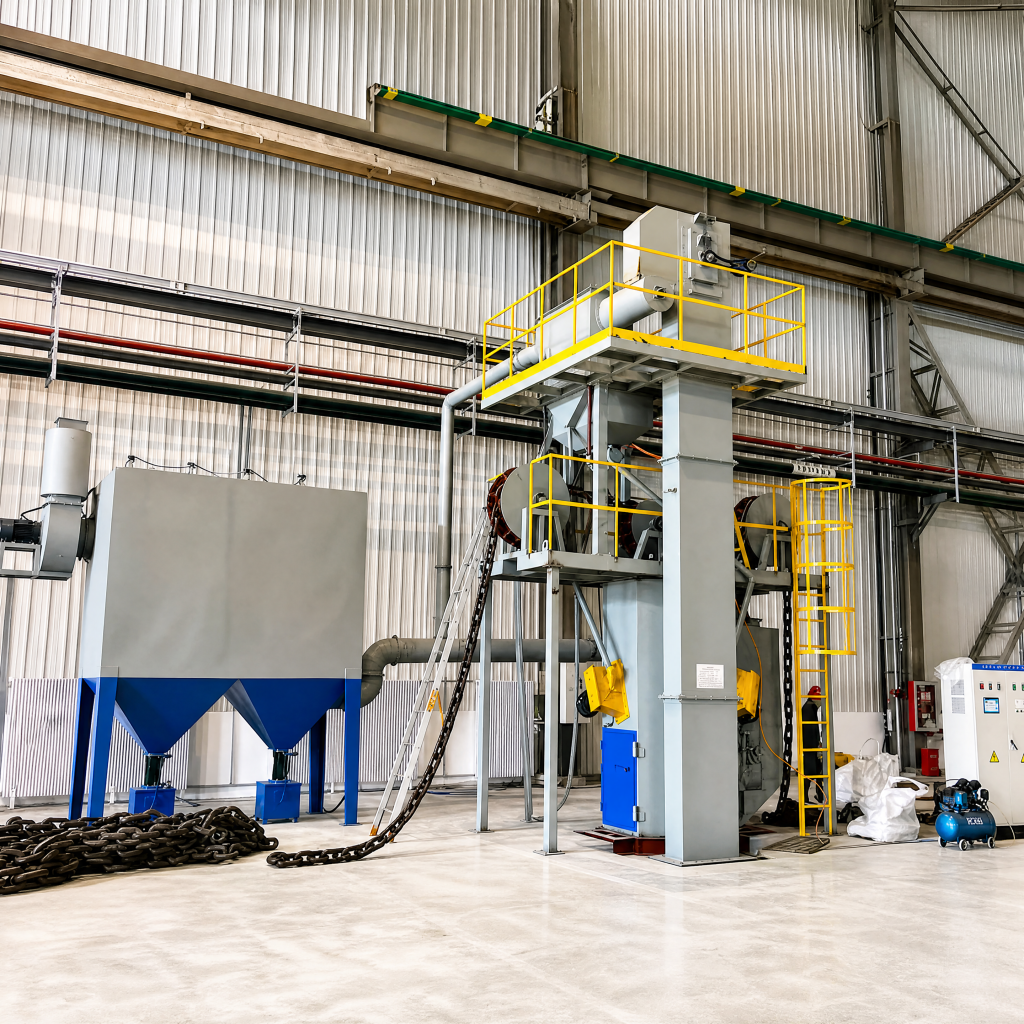
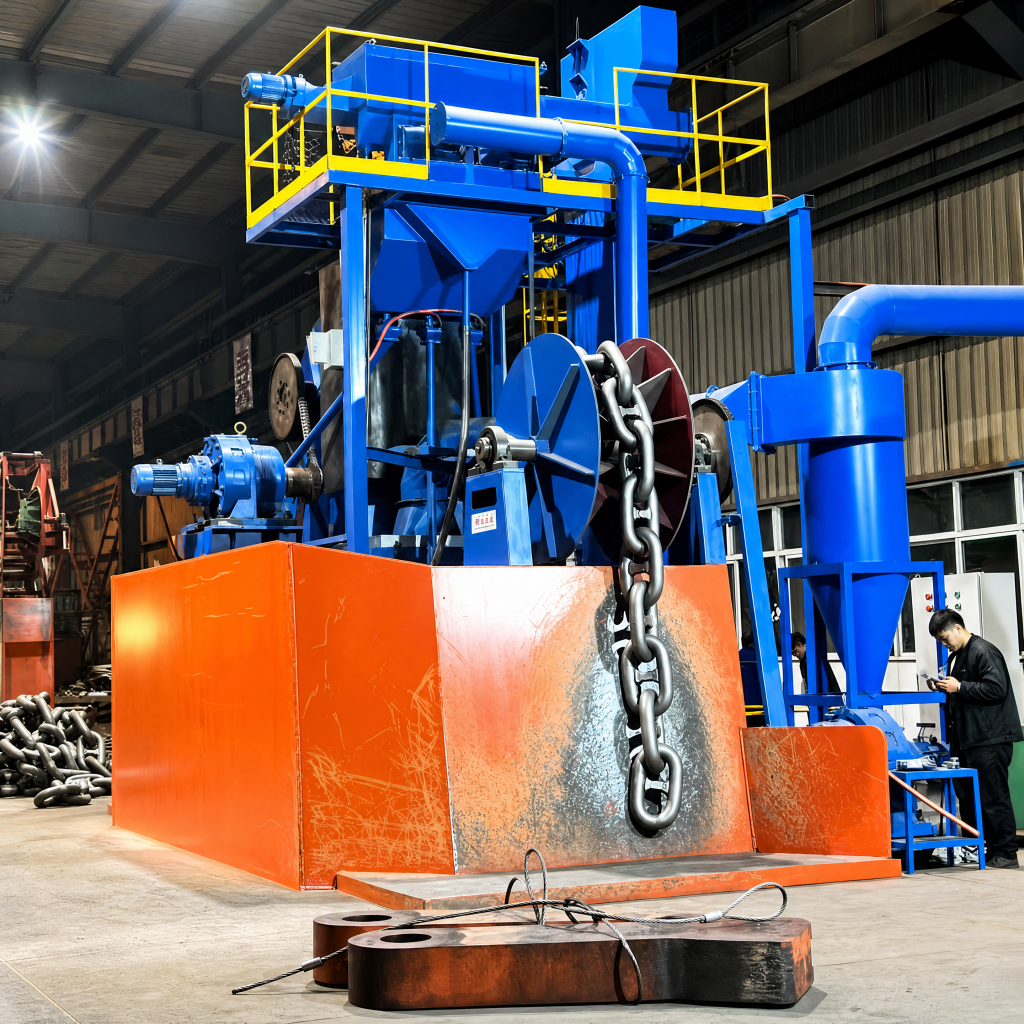
Dedicated Surface Oxide Removal Equipment for Marine Anchor Chains and Mining Chains | GM Series | National Utility Model Patent
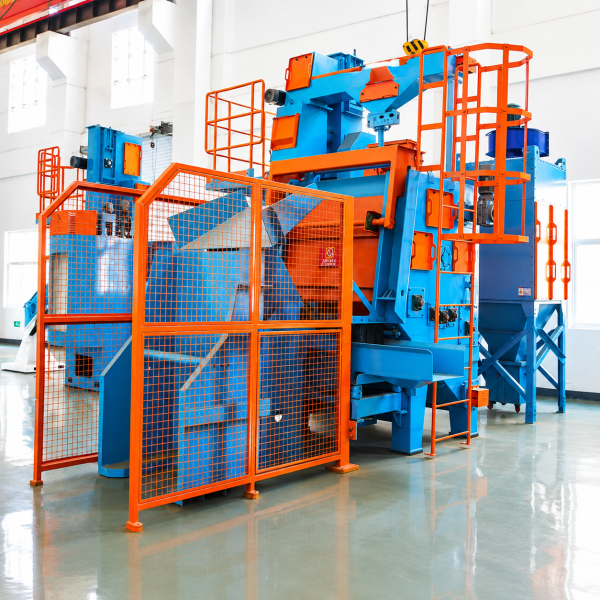
The GM Series Anchor Chain Shot Blasting Machine is special-purpose equipment for marine anchor chains, mining round-link chains, lifting chains, mooring chains, and other chain-shaped workpieces. It uses a sprocket traction system to continuously pull chains through an enclosed blasting chamber, while multiple high-efficiency blast wheels clean the chain from several directions.
The machine removes oxide scale, rust, welding slag, and surface attachments. After cleaning, the chain surface can reach Sa2.5 according to ISO 8501-1, with a typical roughness of Rz 25-60 um, helping the product meet ABS, LR, DNV, CCS, and similar classification inspection requirements.
The anchor chain is placed on the loading rack and pulled into the blasting chamber by a variable-frequency sprocket traction system. During travel, three high-efficiency blast wheels arranged through 3D simulation throw steel shot at the outer circumference, side surfaces, and inner bends of each chain link.
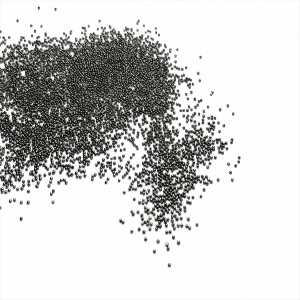
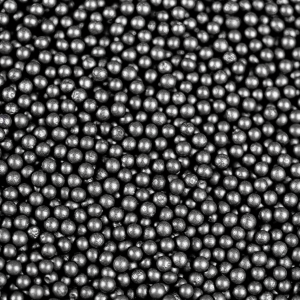
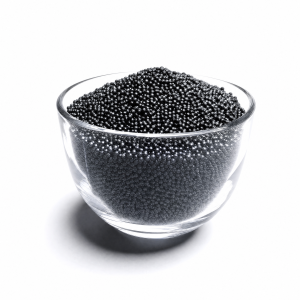
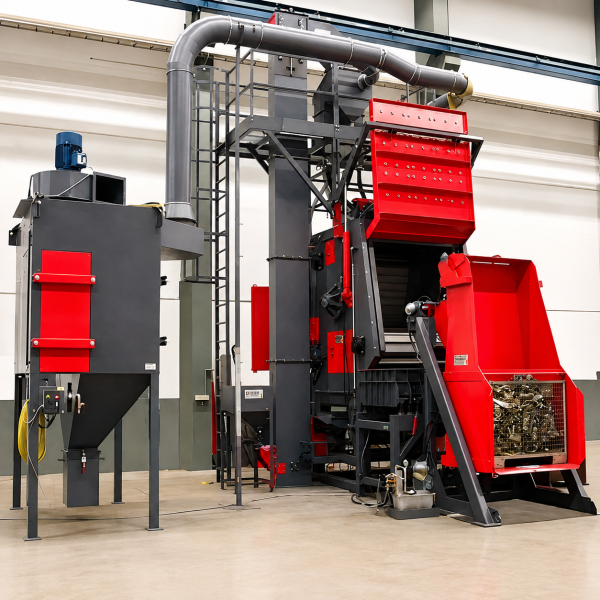
Used abrasive falls into the bottom screw conveyor, is lifted by the bucket elevator, and then passes through a dedicated air separator. Qualified steel shot returns to the blast wheels, while dust and broken abrasive are removed by the dust collection system.
The machine uses direct-drive high-efficiency blast wheels. The motor is directly coupled without a belt, reducing transmission loss and maintenance points. The impeller is 100% dynamically balanced to G6.3, and vibration is controlled at <=4.5 mm/s.
Blades, impeller, control cage, and liners are made of high-chromium wear-resistant cast iron with reference to ASTM A532. Typical hardness is >=58 HRC, and blade life is 2,500-3,000 hours under standard operating conditions.
Blast wheels: high-efficiency direct-drive design; three-wheel angles are optimized by 3D simulation for full coverage of the outer circumference, side surfaces, and inner bends.
Sprocket traction system: variable-frequency drive; sprocket tooth profile matches chain links for high traction, no slipping, and stable speed.
Cleaning chamber: manganese steel or high-chromium cast iron liners, modular 15-20 mm design, and quick replacement.
Guiding device: inlet/outlet guide grooves and limit wheels prevent deviation, tangling, and stacking.
Abrasive circulation system: bottom screw recovery, bucket elevator, and dedicated air separator optimized for anchor-chain conditions; separation efficiency >=99%.
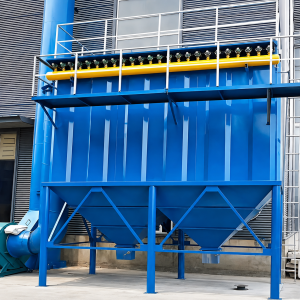
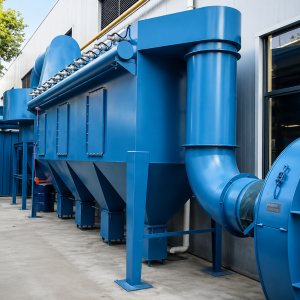
Dust collection system: standard pulse cartridge dust collector, optional bag filter; dust emission <5 mg/m3.
Electrical system: PLC control with Siemens or Mitsubishi optional, touchscreen operation, automatic/manual modes, and optional remote monitoring module.
· GM-80 footprint: approx. 12 m x 5 m including loading, main machine, and discharge sections; recommended plant height >=7 m.
· GM-120 footprint: approx. 15 m x 6 m; recommended plant height >=8 m.
· Reserve anchor chain stacking and turnover space; recommended clearance is >=3 m on each side.
· Concrete foundation flatness should be <=3 mm/m; pre-embedded anchor bolts are required for the main machine and sprocket supports.
· Power supply: 380V/3Ph/50Hz or customized; configure total equipment power with at least 20% margin.
Daily: check blast wheel sound, vibration, and current; check sprocket traction stability; inspect guide groove and limit wheel wear.
Weekly: check wear parts such as blades and liners, replenish grease, and check elevator belt or chain tension.
Every 3-6 months: inspect chamber liners, sprocket tooth wear, blast wheel control cage window position, and dust cartridge or bag pressure differential.
Blade replacement: replace blades when wear exceeds 5 mm or cracks appear.
Sprocket inspection: check tooth surface wear and bearing clearance; replace when tooth wear exceeds 2 mm or tooth chipping appears.
Self-operated import and export rights, supporting FOB, CIF, and DDP trade terms.
Payment methods can include L/C, T/T, or milestone payment according to project requirements.
Overseas installation support includes remote technical supervision, onsite guidance, and turnkey engineering service.
24/7 global response: more than 80% of common faults can be solved remotely within 4 hours.
For urgent onsite needs, local engineers can arrive within 48 hours where service coverage is available; regional spare-parts warehouses can deliver common parts within 48 hours.
|
Parameter |
Unit |
GM-80 |
GM-120 |
|
Applicable anchor chain size (link diameter) |
mm |
dia. 60-80 |
dia. 80-124 |
|
Workpiece running speed |
mm/min |
200-1500 |
200-1500 |
|
Blast wheel quantity |
pcs |
3 |
3 |
|
Single blast wheel power |
kW |
11 |
22 |
|
Total blast wheel power |
kW |
33 |
66 |
|
Total blasting capacity |
kg/min |
360 |
720 |
|
Abrasive diameter |
mm |
dia. 1.2-2.5 |
dia. 1.5-3.0 |
|
Elevator capacity |
t/h |
40 |
60 |
|
Separator capacity |
t/h |
40 |
60 |
|
Dust collection air volume |
m3/h |
12000 |
18000 |
|
Installed power (incl. dust collection) |
kW |
approx. 55 |
approx. 95 |
Notes: 1. The above parameters are reference values for standard models. Non-standard customization is available according to anchor chain specifications and capacity requirements.
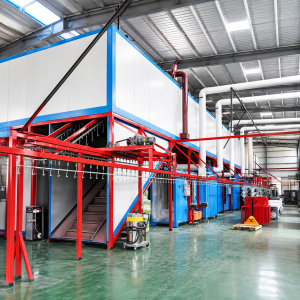
The line is designed for large-scale anti-corrosion and decorative coating of metal workpieces. It fits substrates such as steel plates, aluminum plates, tubes, castings, forgings, and metal frames, covering mainstream global manufacturing sectors including automotive parts, appliance housings, architectural aluminum profiles, precision hardware, construction machinery, high-end furniture, fitness equipment, electronic and electrical enclosures, protective guardrails, and HVAC equipment.
It can complete multi-layer coating processes such as anti-rust primer, anti-corrosion topcoat, and high-gloss clear coat. It is especially suitable for multinational factories and Fortune Global 500 manufacturing bases with high annual output, strict appearance and corrosion-protection standards, and mixed production of multiple product models.
This machine is designed specifically for chain-shaped workpieces. It uses sprocket traction instead of rollers or mesh belts, providing high traction, no slipping, and reliable adaptation to the special geometry of chain links. Blast angles are optimized for the outer circumference and inner bends, while ordinary equipment can easily cause tangling, deviation, and blind spots.
Standard models process marine anchor chains, mining round-link chains, and lifting chains from dia. 60-124 mm. Offshore mooring chains above dia. 200 mm can be customized. Applicable materials include carbon steel, alloy steel, and high-strength offshore mooring steel.
The traction speed is 200-1500 mm/min. As a reference, dia. 80 mm anchor chain at 800 mm/min with two-shift 16 h/day operation can reach approx. 8-12 tons/day.
The surface can typically reach Sa2.5 according to ISO 8501-1, with roughness Rz 25-60 um, meeting ABS, LR, DNV, CCS, and similar requirements. Higher grades can be achieved by reducing running speed or adding blast wheels.
Reference cycles are: blast wheel blades 2,500-3,000 h; chamber liners 3,000-8,000 h; sprocket tooth surface 6,000-10,000 h depending on traction intensity; guide wheels 2-3 years. A spare-parts list and global delivery support are available.
Yes. Sprocket tooth profile, chamber size, blast wheel quantity and power, and traction speed can be customized according to chain diameter, pitch, link type, and capacity target. Free condition diagnosis, 3D simulation, and solution design can be provided.
Please provide chain type (stud-link, studless, or round-link), link diameter and pitch, daily or annual capacity, target cleaning grade (Sa2.5/Sa3), classification certification requirements, plant size and power supply, and local emission standards.

English

Hindi

Indonesian

Russian

Spanish

Thai

Vietnamese