Global Surface Treatment Equipment & System Solutions — Since 2002

久昌机械
Get a Quote
Global Surface Treatment Equipment & System Solutions — Since 2002
久昌机械
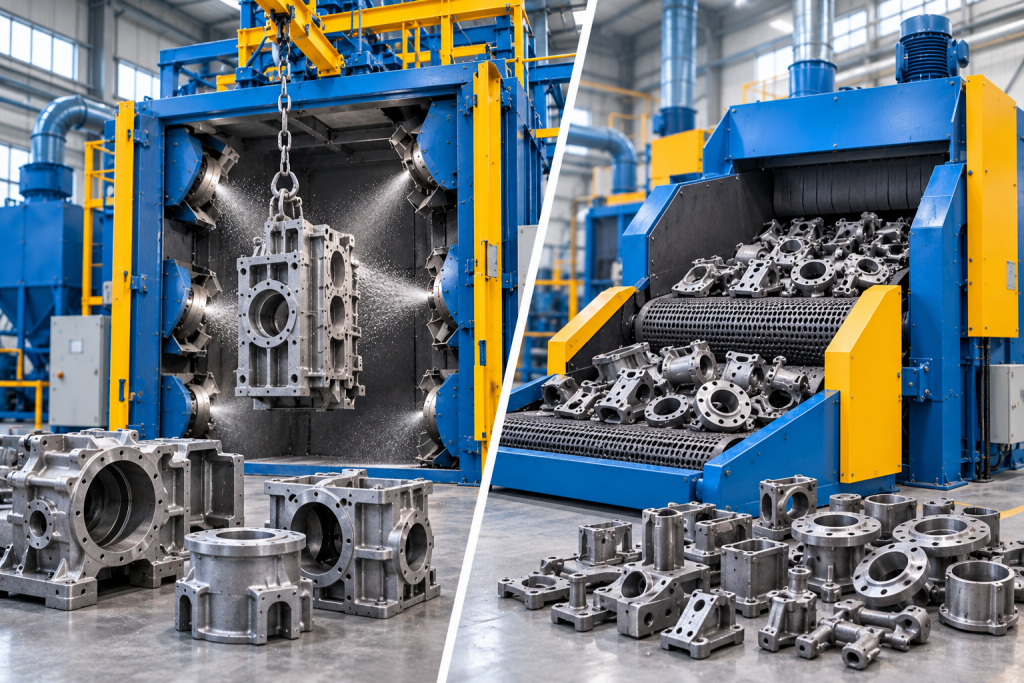
Choose a hook-type shot blasting machine when parts should be suspended and kept apart. Choose a tumble belt machine when small or medium parts can roll together safely in a batch. The decision usually depends on collision tolerance, workpiece geometry, individual weight and the production method rather than the cleaning grade alone.
Both machines can recover and reuse metallic abrasive, automate a cleaning cycle and prepare metal for coating or further processing. Their work-handling systems are fundamentally different. That difference changes loading, surface exposure, batch density, maintenance and total cost.
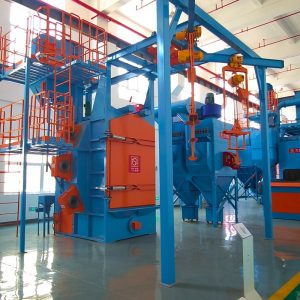
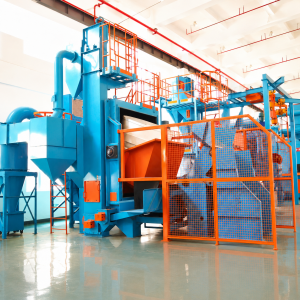
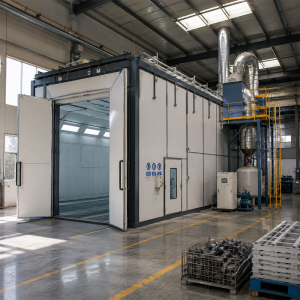
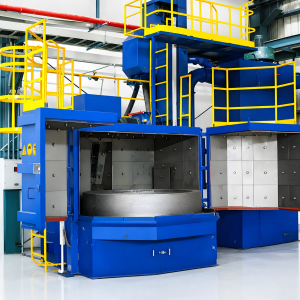
A hook machine suspends one part or a fixture of several parts from a rotating hook. The load moves into the blast chamber, the door closes, and one or more blast wheels project abrasive from fixed positions. Hook rotation presents different faces to the blast pattern. Single-hook machines process one load at a time; double-hook machines can prepare one load while the other is being cleaned.
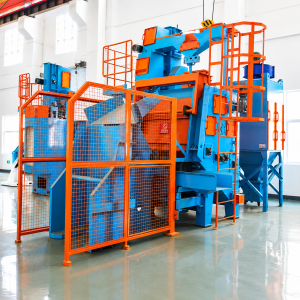
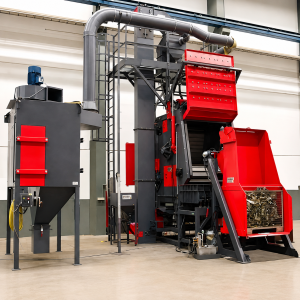
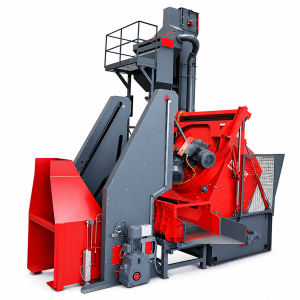
A tumble belt machine carries a batch inside a recessed belt. As the belt moves, the parts roll through the abrasive stream and expose new surfaces. Perforations or gaps allow spent abrasive to fall into the recovery system. Rubber belts cushion the load, while metal belts are used for heavier or sharper parts.
The first decision is therefore simple: can the workpieces tumble and contact one another without unacceptable damage? If the answer is no, a hook or another separated handling method is normally safer.
Hook machines suit medium and large castings, forgings, welded frames, heat-treated parts and irregular components with lifting points. They are also useful when a part has projections, machined areas or cosmetic surfaces that could be damaged in a bulk batch. The hook load and usable hanging envelope must include the fixture and allow the part to rotate without striking the chamber.
Tumble belt machines suit smaller parts that can roll freely, such as selected castings, forgings, fasteners, hardware and heat-treated components. The part must fit the belt geometry and should not bridge, interlock or trap another component. Long, flat, forked or nest-shaped parts can create unstable batches even when their weight is within the nominal limit.
Internal cavities remain a challenge for both systems. Hook rotation can expose different angles, but fixtures or adjacent parts may cast shadows. Tumbling changes orientation repeatedly, but deep pockets can retain media. Sample testing should include the hardest-to-clean surface, not only the broad external face.
A hook system avoids most part-to-part collision because each component is suspended or fixed. It is usually the safer choice for thin walls, sharp machined edges, large gears, fragile projections and parts with a visible finished surface. Contact can still occur if several pieces share a poorly designed fixture or swing during rotation.
Tumble belt machines depend on controlled contact. A rubber belt softens impact against the conveyor, but it cannot prevent parts from striking one another. Buyers should consider material hardness, edge condition, unit weight, drop distance and batch fill. A trial should check dents, chipping, distortion, edge rounding and changes to dimensional features.
Hook production is organized around loads and fixtures. A single-hook layout offers flexibility for small batches and varied workpieces. A double-hook layout reduces auxiliary time because loading and unloading can occur outside the chamber while the other hook runs. Overhead conveyor systems extend the same suspended principle into continuous or indexed production.
Tumble belt production is organized around batch weight and cycle time. Bulk loading can create high part density and efficient labor use when parts are uniform and tumble-safe. Automatic hoppers, belt reversal and vibrating discharge conveyors can reduce manual handling. The real capacity is limited by how well the batch turns, not only by the published maximum load.
For either machine, calculate total cycle time from load preparation through discharge. A hook machine may spend more time on rigging and fixtures. A tumble belt may need sorting, gentler loading or extra abrasive removal. The better choice is the one that meets the hourly target with a stable, repeatable material flow.
Hook rotation provides controlled exposure around a suspended part. Coverage depends on wheel angle, rotation speed, fixture position and whether one part blocks another. It works well when the supplier can define a repeatable hanger and maintain space between components.
Tumbling continuously changes part orientation, which can produce broad all-around exposure on compact shapes. Consistency falls when parts clump, interlock or form a stable layer. Batch weight, belt speed and fill level should be controlled as part of the recipe.
Neither handling method guarantees a particular cleaning grade by itself. Abrasive mix, wheel settings, initial condition and exposure still determine the result. Use representative trials and agree on inspection locations for surfaces most likely to remain shadowed.
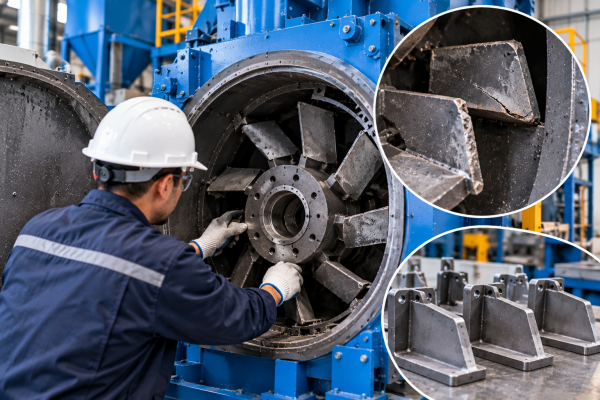
Hook machines require inspection of hooks, hoists, tracks, rotation drives, doors, seals, chamber liners and wheel wear parts. Fixtures also need attention because wear or deformation can change part orientation and coverage. Double-hook systems add handling hardware but can protect production from loading delays.
Tumble belt machines require inspection of the belt, links or slats, support rollers, loading system, chamber liners, seals and discharge equipment. Rubber belts can be cut by burrs or overloaded parts. Metal belts tolerate heavier impact but introduce harder part contact. Belt condition directly affects batch movement and therefore the cleaning result.
Compare cost per accepted part rather than purchase price alone. Include fixtures, loading labor, belt or hook maintenance, wear parts, abrasive carryout, energy, planned downtime and rework caused by incomplete coverage or part damage.
First, eliminate any option that cannot safely handle the part. If components may not collide, cannot roll freely or require fixed orientation, start with the hook concept. If the parts are compact, robust and proven to tumble without interlocking, keep the tumble belt concept in the comparison. This screening prevents production-rate estimates from making an unsuitable handling method appear attractive.
Second, compare the remaining options at the required hourly output. Build a cycle model that includes external loading, fixture preparation, chamber time, unloading, media removal and inspection. A double-hook machine can hide part of the loading time, while an automated tumble system can reduce manual labor. The advantage depends on actual plant flow, not the nominal blast time alone.
Finally, run representative trials and price the complete operating package. Inspect cleaning coverage and part damage, then compare fixtures, automation, wear parts, abrasive consumption, energy and service support. Record the trial settings and require the quotation to identify all assumptions. This makes the hook-versus-tumble decision traceable and easier to defend during technical review.
| Workpiece | Hook type | Tumble belt | Main reason | Check before purchase |
| Large pump or valve body | Usually preferred | Usually unsuitable | High unit weight and irregular geometry | Hook balance and cavity coverage |
| Welded frame | Preferred | Unsuitable | Must retain shape and remain separated | Fixture shadows and rotation envelope |
| Medium gears | Preferred for protected edges | Possible if contact is acceptable | Collision tolerance controls the choice | Edge damage and abrasive retention |
| Fasteners and robust hardware | Possible on fixtures | Usually preferred | High batch density and free tumbling | Interlocking and unloading |
| Thin or delicate castings | Usually preferred | Use only after trials | Part-to-part impact may deform or chip | Minimum wall and fragile features |
| Small aluminum parts | Possible with dedicated setup | Possible with rubber belt and testing | Contamination and marking need control | Approved abrasive and sample finish |
A hook machine is generally safer because parts can be separated and supported. Thin-wall parts can still distort if blast intensity or exposure is excessive, so the wheel settings and fixture need validation.
The allowable weight depends on the model and handling design. Hook machines are specified by load per hook and hanging envelope. Tumble machines have both a maximum single-part weight and a maximum batch load. Use supplier-approved values for the selected model and include fixtures in the calculation.
A double-hook layout allows one hook to be loaded or unloaded while the other is inside the chamber. This reduces non-blasting time when the plant can prepare loads safely and consistently.
Yes. Many systems can use loading hoppers, belt reversal and discharge conveyors. Automation should be designed around part damage risk, batch measurement, upstream containers and the required separation after unloading.
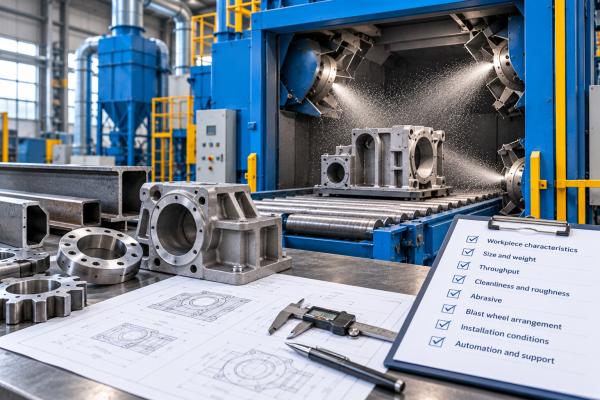
Send JC Blasting the workpiece photos or drawings, single-part weight, batch quantity, required finish and whether part-to-part contact is allowed. The engineering team can compare hook and tumble belt concepts and recommend the handling method, sample test and machine configuration for your application.

English

Hindi

Indonesian

Russian

Spanish

Thai

Vietnamese