Global Surface Treatment Equipment & System Solutions — Since 2002

久昌机械
Get a Quote
Global Surface Treatment Equipment & System Solutions — Since 2002
久昌机械
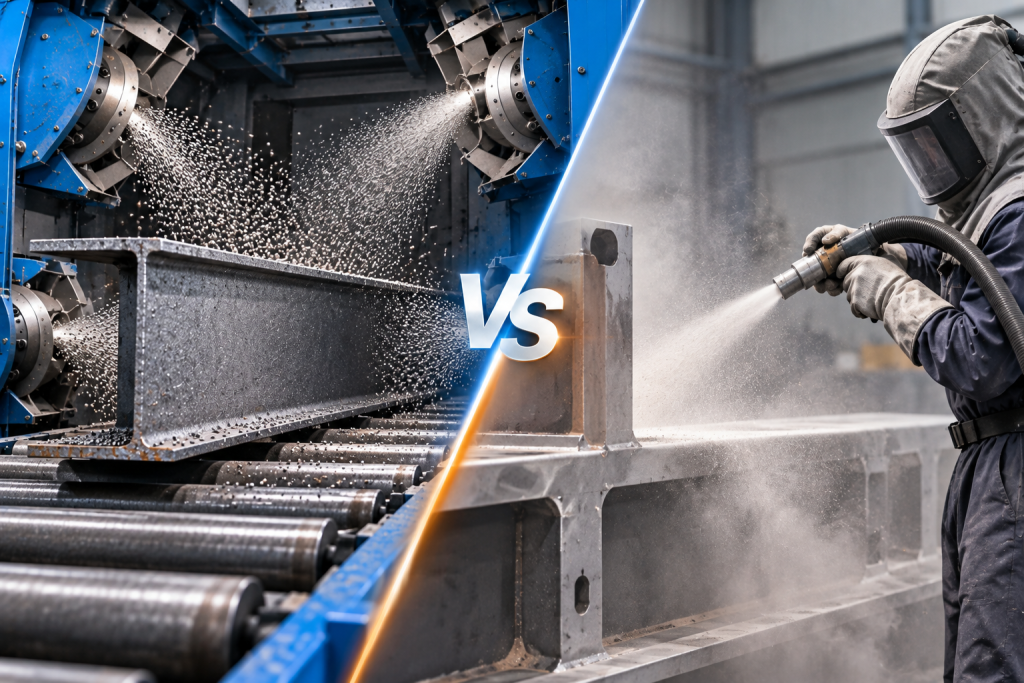
Shot blasting and sandblasting are abrasive blasting processes used to clean and prepare surfaces, but they deliver the abrasive in different ways. Shot blasting usually refers to wheel-blast equipment that throws metallic abrasive with a rotating wheel. Sandblasting commonly refers to air blasting, where compressed air carries abrasive through a nozzle.
Neither process is universally better. Shot blasting often suits repeatable, high-volume cleaning of metal parts that can move through an enclosed machine. Air blasting offers more flexibility for very large structures, complex geometry, localized work and materials that need lower or more adjustable impact. The choice should follow the workpiece, finish and production method.
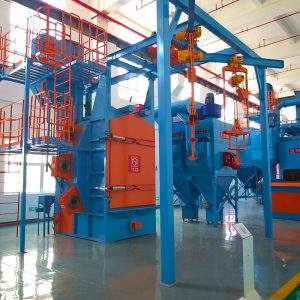
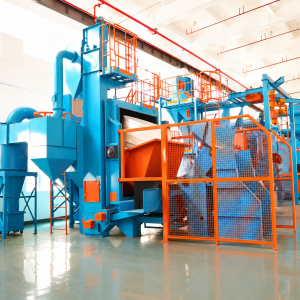
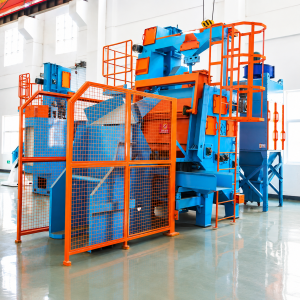
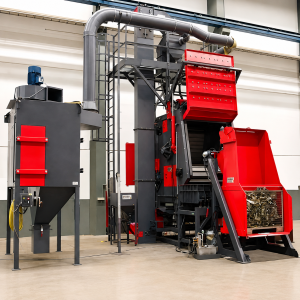
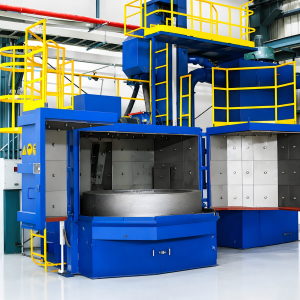
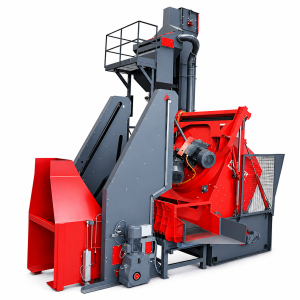
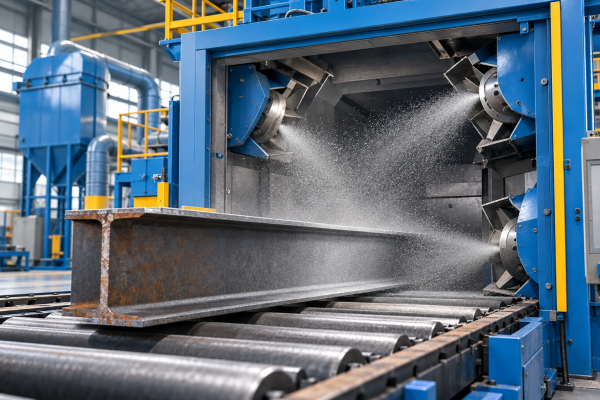
A wheel-blast machine meters steel shot or grit into a high-speed blast wheel. The wheel blades accelerate the abrasive and project it in a controlled pattern. The workpiece tumbles, rotates, hangs or travels through the pattern while the enclosure contains the media. Conveyors and a separator recover, clean and recirculate usable abrasive.
Because the wheel moves a large mass of abrasive without compressed air as the primary accelerator, the process can clean large surface areas efficiently. It is well suited to automated treatment of castings, forgings, plate, profiles, welded structures, pipes and other steel products.
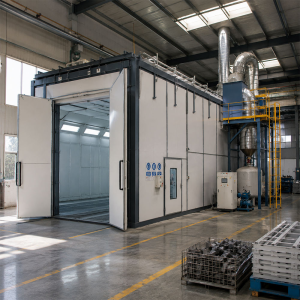
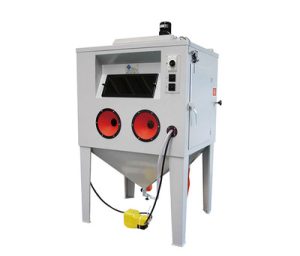
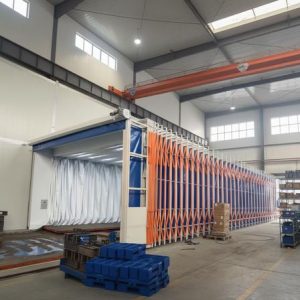
An air-blast system mixes abrasive with compressed air and directs the stream through a nozzle. The operator or an automated manipulator can aim the nozzle at edges, recesses, welds and selected areas. Blast rooms allow large workpieces to be treated manually, while cabinets and automated air-blast machines handle smaller parts.
The word sandblasting remains common, but modern operations may use garnet, aluminum oxide, glass bead, steel abrasive or other media instead of silica sand. Media selection must consider the substrate, desired profile, contamination risk, dust-control plan and health and environmental requirements.
Both processes can remove rust, scale, old coatings and manufacturing residue. The main difference is the way impact energy and coverage are delivered.
Specify the required cleanliness and roughness before choosing equipment. If the surface will receive a coating, confirm the acceptable profile with the coating system. Cleanliness and roughness should be inspected using the agreed standard and instruments on representative parts.
Workpiece geometry often decides the process before cost calculations begin.
| Workpiece condition | Shot blasting fit | Sandblasting or air-blast fit |
| Small bulk parts that may tumble | Strong fit for tumble belt or drum batch cleaning | Possible in a cabinet, but usually more manual or lower throughput |
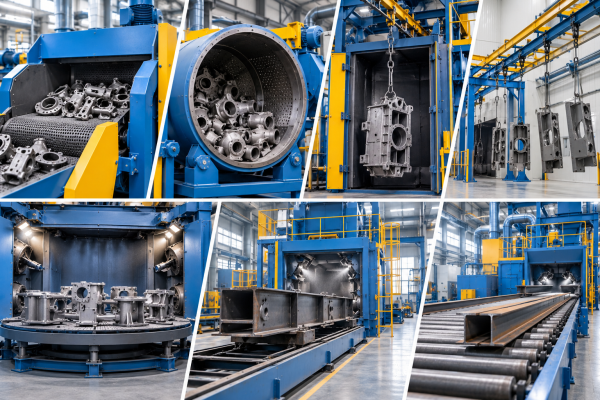
| Medium or large parts with lifting points | Hook or overhead conveyor systems provide repeatable exposure | Useful for complex recesses, touch-up and lower-volume work |
| Plate, beams and long profiles | Roller conveyor systems provide continuous cleaning | Suitable when volumes are low or the structure cannot pass through a machine |
| Very large fabricated structures | Possible in trolley or custom machines if the envelope and economics justify it | Blast rooms offer flexible access around large structures |
| Thin, soft or easily marked parts | Requires careful testing; wheel impact may be excessive | Air pressure and media can be adjusted more finely |
| Parts with deep recesses or localized areas | May have shadow zones unless fixtures and wheel positions are optimized | A directed nozzle can target selected areas |
Material also matters. Steel abrasive can contaminate stainless steel or non-ferrous parts if the application does not allow ferrous carryover. Glass bead, aluminum oxide or another dedicated medium may be more suitable. Any process used on soft alloys, thin sections or precision surfaces should be validated with sample parts.
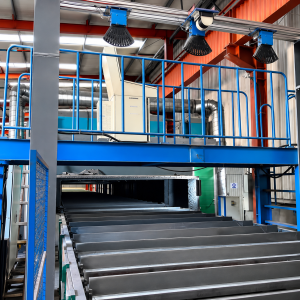
Shot blasting has a strong advantage when the workpiece family is stable and production volume justifies dedicated handling. A roller conveyor can feed a fabrication line, an overhead conveyor can move parts through pretreatment and paint, and a tumble belt machine can process repeatable batches with limited manual nozzle work.
Air blasting can also be automated, but many sandblasting applications rely on manual nozzle control. Manual work is valuable when every component is different or when access changes from one job to the next. It becomes harder to predict cycle time and finish consistency as volume rises.
Compare complete cycle time, not blasting time alone. Include loading, masking, fixture changes, part turning, abrasive blow-off, inspection and unloading. A fast blast wheel does not improve throughput if the crane or fixture creates a queue. A flexible blast room may outperform a dedicated machine when job sizes change constantly.
Wheel-blast machines normally operate as a closed loop. Screw conveyors and elevators return media to a separator, which removes dust and debris before reuse. Metallic abrasive gradually breaks down and is lost through carryout, so operators add new media to maintain the operating mix.
Blast rooms can also recover abrasive, using sweep-in, screw, pneumatic or mechanical systems. Recovery level depends on the room design and media. A simple manual setup may require more labor for collection and cleanup than an integrated wheel-blast machine.
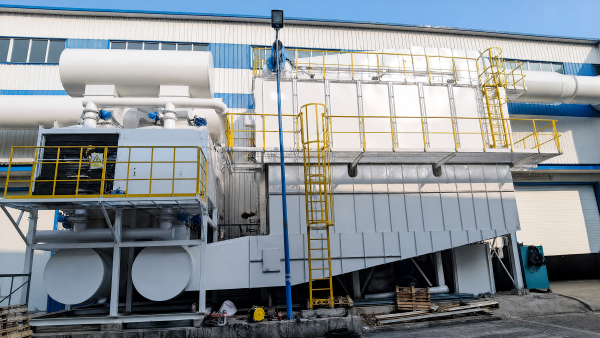
Both processes generate dust from the surface contamination, coating and broken abrasive. Enclosures, ventilation and dust collection are essential. The collector must be sized for the process, and the removed material must be handled according to its composition and local rules. Old coatings can introduce hazardous constituents that require special assessment.
Wheel blasting uses electric motors to accelerate abrasive and also powers conveyors, elevators and dust collection. Air blasting depends heavily on compressed air, which can be a costly plant utility. Actual operating cost depends on machine utilization, motor and compressor efficiency, abrasive consumption, labor, filter service and wear parts.
Wheel systems require inspection of blades, control cages, impellers, liners, seals and conveyors. Air-blast systems require attention to nozzles, hoses, metering valves, moisture control and compressor performance. The better process is the one the plant can maintain consistently at the required production rate.
| Decision factor | Shot blasting is often preferred when | Sandblasting or air blasting is often preferred when |
| Production volume | Parts repeat and throughput is medium to high | Jobs are low volume, varied or project-based |
| Workpiece movement | Parts can tumble, hang, rotate or pass through a machine | The workpiece must remain in place or needs manual access |
| Geometry | Main surfaces can cross fixed blast patterns | Recesses, local areas and changing shapes require directed nozzles |
| Automation | The process should integrate with a conveyor or production line | Operator control and flexibility are more important |
| Media | Reusable metallic shot or grit is acceptable | Non-metallic or contamination-controlled media is required |
| Floor space | A dedicated machine and material flow can be installed | A room or cabinet better fits the work mix |
| Consistency | A repeatable recipe and controlled exposure are priorities | The operator must adapt the process to each job |
For borderline applications, a practical test is more valuable than a generic comparison. Process the same representative part using the proposed abrasive and equipment, then compare cleanliness, roughness, coverage, cycle time, media carryout and any dimensional or cosmetic change.
No. Both are abrasive blasting methods, but shot blasting commonly uses a rotating wheel to propel abrasive, while sandblasting uses compressed air and a nozzle. The equipment layout, energy source, media options and ideal applications differ.
Shot blasting is often faster for repeatable, high-volume cleaning because wheel systems move a large abrasive flow and can automate workpiece handling. Sandblasting can be faster for localized areas or one-off structures because the nozzle can be aimed directly without designing a dedicated handling system.
The better finish is the one that meets the specified cleanliness and profile without damaging the substrate. Both processes can produce excellent coating-preparation surfaces. Abrasive shape and size, impact energy, angle, exposure and initial condition have more influence than the process name alone.
Wheel-blast machines are generally designed for durable metallic media such as steel shot or grit. Sand and many lightweight mineral abrasives can break down rapidly, create excessive dust or fail to flow correctly through the wheel and recovery system. Use only media approved for the specific machine.
Yes. Surface contamination and abrasive breakdown create dust in both processes. The enclosure, ventilation, collector, filter and waste-handling system must match the material being removed and applicable workplace and environmental requirements.
If you are comparing shot blasting and sandblasting, send JC Blasting the workpiece material, dimensions, weight, photos, current surface condition, required finish and target output. The engineering team can assess whether a wheel-blast machine, sandblasting room or another abrasive blasting setup is the better fit and can propose sample testing before equipment selection.
These links support the article’s topic cluster and guide readers toward relevant product pages. Add them with descriptive anchor text where they fit naturally in the published page.
Abrasive products: https://www.jcblasting.com/products/abrasive/

English

Hindi

Indonesian

Russian

Spanish

Thai

Vietnamese